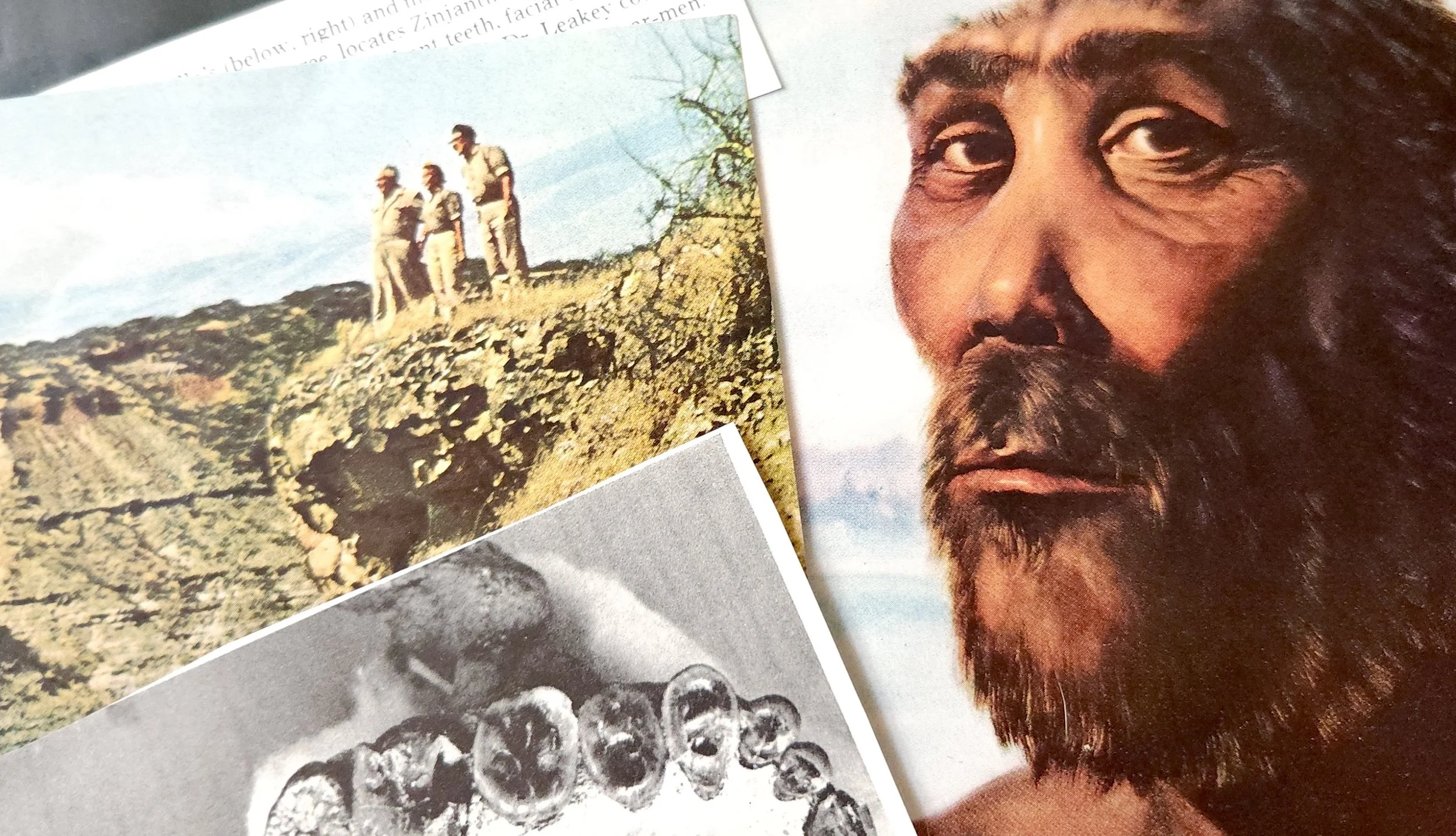
Images from September 1960 issue of National Geographic Magazine, cut out and photographed
In his second term, Donald Trump has signed 217 executive orders, many of which have aimed to undermine individuals, universities, and other entities engaged in scientific research (Federal Register). They have slashed budgets and thinned out workforces at the National Institutes of Health, the National Science Foundation, the Environmental Protection Agency, and the National Park System.
For many Americans, what these entities represent is opaque and abstracted. They are the places that tax dollars go, never to be seen again. In reality, these agencies shape American life. They are responsible for America’s healthcare breakthroughs, our technological edge, our long lifespans, and our beautiful landscapes.
As a biological anthropologist, I study human nature and evolution. My friends, colleagues, and I have all chosen to spend years and even decades investigating specific questions that come together in an effort to answer one big one: “What does it mean to be human?”
In the eyes of the current administration, this question is for navel gazers. In ours, it is vital to those of us who want to understand where we came from, what we are doing, and how in the world we can survive.
Biological anthropology’s beginnings would have aligned nicely with the current administration’s unspoken ideals. In the early 1900s, physical anthropologists were eager to use their findings to justify eugenics and promote ideas about racial hierarchies and progressive evolution (Baker, 1988; Soderstrom, 2004).
Thankfully, the field has become more diverse in both its practitioners and research. Since then, biological anthropologists have discovered fossils of early human ancestors, used DNA to trace different lineages through time, and identified remains along the United States Border and in sites like the African Burial Ground in Manhattan. Biological anthropology is a wide and malleable field that integrates with other disciplines to add a uniquely human perspective.
Earlier this year, the National Science Foundation (NSF), a federal agency that funds and supports science in the US, updated its priorities. They maintain that they will continue to base decisions on each award’s “potential to advance new knowledge” and its “impact on the Nation and its People.” But with political conservatives calling the shots, and Project 2025 as the blueprint, the connotations of “intellectual merit” and “broader impacts” have changed (Garisto, 2025).
In November of 2025, NSF’s Doctoral Dissertation Research Improvement Grants for Biological Anthropology and Archaeology were both archived. As the main sources of funding for PhD students in these fields, and with departments already struggling with tight budgets, this is disastrous for the future of anthropology in this country.
If the administration continues down this path, anthropology as we know it will suffer, and the public will lose out, not only on punchy stories about a new find that changes “everything we know” about human evolution or a long-gone civilization, but on thoughtful perspectives and discoveries about our place in the global community.
We are already living in a world where our existence is so far detached from our surroundings that many of us hardly consider where our food originates, who makes the products we buy, and how our actions impact the environment. This narrow way of perceiving the world is already contributing to climate change and its cascading effects on humanity.
Suppressing biological anthropologists’ perspectives by defunding our programs and doing the same in other scientific fields will have devastating consequences. It will revert US scientific research to pre-World War II conditions, before the American government began heavily investing in scientific research (Blevins, 2020).
Vannevar Bush, an architect of the NSF and the head of the Office of Scientific Research and Development during World War II, said. “New impetus must be given to research in our country. Such new impetus can come promptly only from the Government. Expenditures for research in the colleges, universities, and research institutes will otherwise not be able to meet the additional demands of increased public need for research.” (Blevins, 2020). This was true in 1945, and it is true today.
The US administration’s vendetta against critical thinking is not only short-sighted; it is dangerous. Any short-term economic or political benefits will be vastly outweighed by the loss they will bring. As we reach the end of Donald Trump’s first year back in office, sitting quietly and hoping for the best will get us nowhere.
When confronted with big problems, it helps to step back and consider the context. As biological anthropologists, we are trained to do exactly that. Now is the time when America chooses: embrace science and value its impacts on American life, or reject it — to everyone’s disadvantage.
I originally submitted this op-ed for a 2026 William S. Pollitzer Student Travel Award from the American Association for Biological Anthropologists (and was awarded the prize).
References:
2025 Donald J. Trump Executive Orders. Federal Register, https://www.federalregister.gov/presidential-documents/executive-orders/donald-trump/2025
Baker, Lee. 1998. From Savage to Negro: Anthropology and the Construction of Race 1896–1954. First edition. University of California Press
Blevins, E. G. (2025). NSF and postwar US science. Physics Today, 78(5), 38–44. https://doi.org/10.1063/pt.tqny.kauo
Garisto, D. (2025). How Trump is following Project 2025’s radical roadmap to defund science. Nature, d41586–025–00780–00782. https://doi.org/10.1038/d41586-025-00780-2
Soderstrom, M. (2004). Family Trees and Timber Rights: Albert E. Jenks, Americanization, and the Rise of Anthropology at the University of Minnesota. The Journal of the Gilded Age and Progressive Era, 3(2), 176–204.
Updates on NSF Priorities. U.S. National Science Foundation, https://www.nsf.gov/updates-on-priorities